AQA GCSE Biology Revision Notes, Flashcards & Practice Questions
Aripsy turns your AQA GCSE Biology notes, textbook pages, or class handouts into revision notes, flashcards, and exam-style MCQs. Paste one topic or upload a supported PDF on Pro, then revise the 7-topic structure across Paper 1 and Paper 2.
50,000+
Students
4.9
Rating
50+
Countries
Biology
GCSE / SAT
AQA
Pro unlocks PDFs, MCQs, fill-blanks, PDF export, and Anki export.
Short answer
What is AQA GCSE Biology revision notes?
Aripsy turns your AQA GCSE Biology notes, textbook pages, or class handouts into revision notes, flashcards, and exam-style MCQs. Paste one topic or upload a supported PDF on Pro, then revise the 7-topic structure across Paper 1 and Paper 2. It is designed for exam revision for GCSE AQA Biology, with outputs students can review, practise from, and export where their plan supports it.
Best input
Paste one AQA GCSE Biology topic at a time, such as cell biology notes, a photosynthesis handout, a required practical method, or copied textbook text.
Responsible use
Use Aripsy alongside your AQA specification, class notes, course materials, and past-paper mark schemes. AI output should be checked before exam revision.
AQA GCSE Biology Revision Notes, Flashcards & Practice Questions
Aripsy turns your AQA GCSE Biology notes, textbook pages, or class handouts into revision notes, flashcards, and exam-style MCQs. Paste one topic or upload a supported PDF on Pro, then revise the 7-topic structure across Paper 1 and Paper 2.
Why use this AI Biology Notes Generator?
How to Generate Study Notes
Common Questions
Can Aripsy make AQA GCSE Biology revision notes?
Does this cover AQA Biology Paper 1 and Paper 2?
Can Aripsy create AQA Biology flashcards?
Are the generated notes official AQA materials?
How is Aripsy different from StudyFetch or Turbolearn for GCSE Biology?
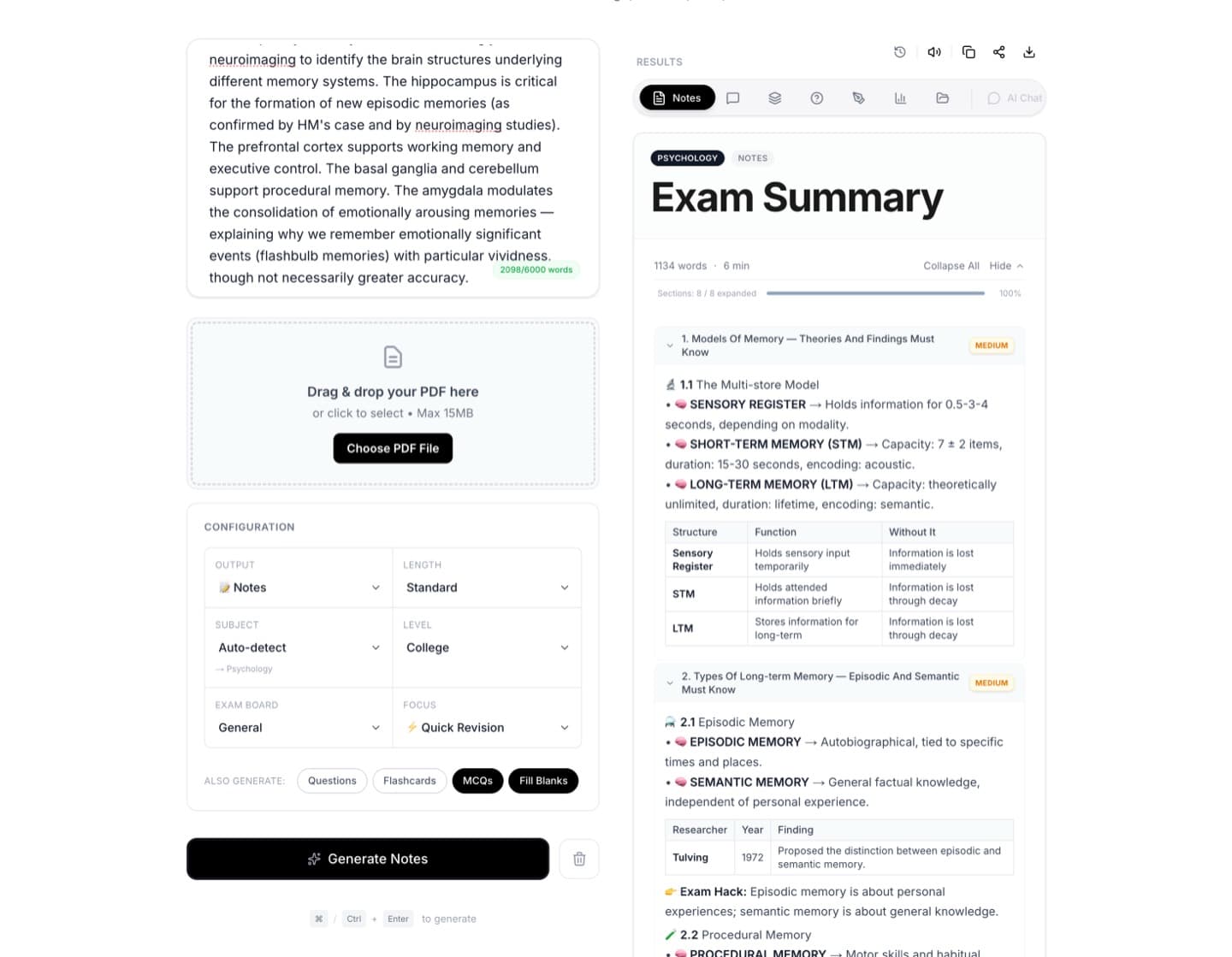
Product workflow preview
What the workflow looks like in Aripsy
Students can paste a focused AQA GCSE Biology topic, choose Biology and AQA settings, generate notes, then turn checked points into flashcards or practice questions.
What is covered in AQA GCSE Biology?
AQA GCSE Biology is commonly revised across seven topic areas: cell biology, organisation, infection and response, bioenergetics, homeostasis and response, inheritance, variation and evolution, and ecology. Aripsy helps students turn their own notes for each topic into shorter explanations and recall prompts.
AQA Biology Paper 1 revision topics
Paper 1 revision usually focuses on cell biology, organisation, infection and response, and bioenergetics. Useful inputs include microscopy notes, enzyme practicals, pathogen comparisons, vaccination explanations, photosynthesis equations, and respiration examples.
AQA Biology Paper 2 revision topics
Paper 2 revision usually focuses on homeostasis and response, inheritance, variation and evolution, and ecology. Students often need precise wording for negative feedback, genetic crosses, natural selection, sampling methods, biodiversity, and carbon or water cycle explanations.
Sample AQA Biology flashcards
Example cards include: What is osmosis? The movement of water across a partially permeable membrane from a dilute solution to a more concentrated solution. What is a limiting factor in photosynthesis? A condition that restricts the rate, such as light intensity, carbon dioxide concentration, or temperature.
Common mistakes to check before revising
Students often mix up diffusion, osmosis, and active transport; describe respiration as breathing; forget to link structure to function; or write vague ecology answers without method details. Generated notes should be checked against class notes, the AQA specification, and mark schemes.
How to revise AQA Biology with Aripsy
Use one focused topic at a time. Paste your notes, generate a structured summary, check the output, then create flashcards or MCQs from the corrected material. This keeps Aripsy in the role of study assistant rather than a replacement for learning or official exam guidance.
Useful student workflows
Paper 1 topic review
Turn notes on cells, organisation, infection and response, or bioenergetics into shorter revision notes and recall prompts.
Paper 2 weak areas
Use homeostasis, inheritance, evolution, and ecology notes to create flashcards for terms and questions for process explanations.
Required practical recap
Paste method notes and convert them into variables, steps, safety points, and common exam questions to check understanding.
Why a focused AQA Biology page is stronger than a generic notes page
AQA GCSE Biology revision has a recognisable topic structure, common command words, and repeated areas where students lose marks. A useful page should name those topics, show realistic flashcard examples, and remind students to check practical wording and definitions. This makes the page more helpful than a generic AI notes page with only the subject swapped into the heading.
What to paste for better AQA Biology notes
The best input is a focused extract from one topic: a class handout, textbook section, copied PDF text, required practical method, or mark-scheme correction. Include diagrams as explanatory text where possible. If you paste a whole course at once, the output is more likely to become shallow and harder to verify.
Turning Biology notes into active recall
After checking the generated notes, turn key definitions into flashcards, processes into sequence prompts, and common mistakes into self-check questions. For example, photosynthesis can become equation recall, limiting-factor interpretation, and required-practical variable checks. This moves revision beyond passive rereading.
Sources and further reading
These independent education resources inform the study habits discussed on this page. Always follow your teacher, tutor, specification, or official exam guidance first.
Topics Supported
Ready to revise with less friction?
Join over 50,000 students using Aripsy to study smarter, not harder.
Supported Subjects
Biology, Chemistry, Physics, Mathematics, History, Geography, Economics, Business, Psychology, Computer Science, English Literature.
Perfect for
CORE TOOLS
EXAM SPECIFIC
Explore More AI Study Tools
📐 AQA GCSE Maths
Revise AQA GCSE Maths with method notes, formula flashcards, and practice prompts.
📖 AQA GCSE English Literature
Revise set texts, quotes, themes, and poetry comparisons with checked study prompts.
📐 Edexcel GCSE Maths
Revise Pearson Edexcel Maths with method notes, flashcards, and practice prompts.
🧬 Edexcel GCSE Biology
Revise Pearson Edexcel Biology with notes, flashcards, practical checks, and questions.
🧬 AQA A-Level Biology
Revise AQA A-Level Biology with topic notes, required practicals, and essay prompts.
🧠 AQA A-Level Psychology
Revise AQA Psychology with AO1, AO2, AO3, research methods, and evaluation prompts.