AQA A-Level Psychology Revision Notes, Flashcards & Evaluation Prompts
Aripsy turns your AQA A-Level Psychology notes, study summaries, evaluation paragraphs, or research methods material into revision notes, flashcards, and practice prompts. Check which AQA Psychology specification your cohort uses, then paste one topic at a time for clearer revision.
50,000+
Students
4.9
Rating
50+
Countries
Psychology
hard
AQA
Pro unlocks PDFs, MCQs, fill-blanks, PDF export, and Anki export.
Short answer
What is AQA A-Level Psychology revision notes?
Aripsy turns your AQA A-Level Psychology notes, study summaries, evaluation paragraphs, or research methods material into revision notes, flashcards, and practice prompts. Check which AQA Psychology specification your cohort uses, then paste one topic at a time for clearer revision. It is designed for exam revision for A-Level AQA Psychology, with outputs students can review, practise from, and export where their plan supports it.
Best input
Paste one AQA A-Level Psychology topic at a time, such as attachment notes, biopsychology, psychopathology, research methods, issue-and-debate notes, or evaluation paragraphs.
Responsible use
Use Aripsy alongside the AQA Psychology specification for your cohort, class notes, textbooks, studies, and mark schemes. Check study details, evaluation wording, and assessment objectives before revision.
AQA A-Level Psychology Revision Notes, Flashcards & Evaluation Prompts
Aripsy turns your AQA A-Level Psychology notes, study summaries, evaluation paragraphs, or research methods material into revision notes, flashcards, and practice prompts. Check which AQA Psychology specification your cohort uses, then paste one topic at a time for clearer revision.
Why use this Tool?
How to Generate Study Notes
Common Questions
Can Aripsy make AQA A-Level Psychology revision notes?
Can Aripsy help with AO1, AO2, and AO3?
Can Aripsy create Psychology flashcards?
Which AQA Psychology specification should I use?
Are generated Psychology notes official AQA answers?
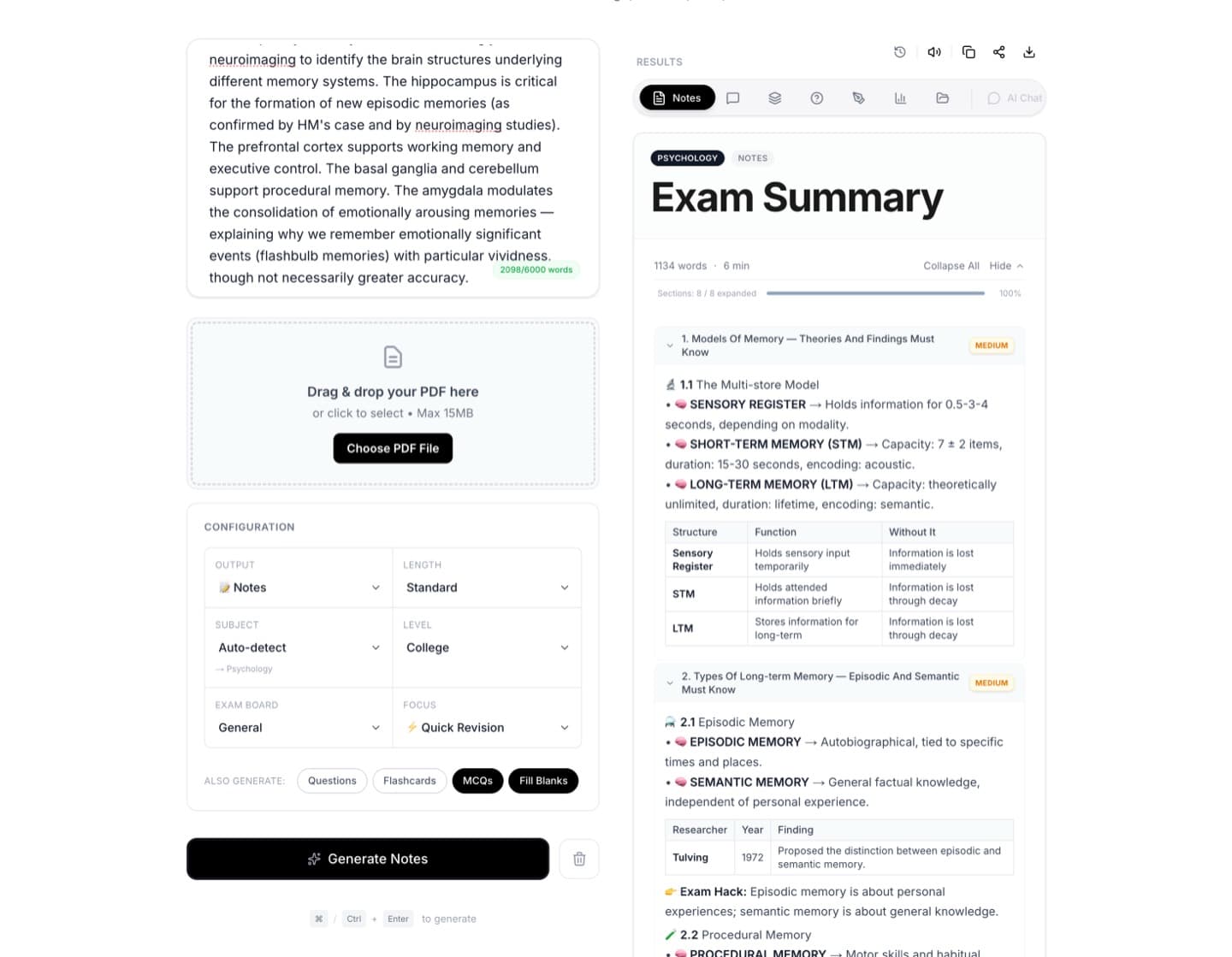
Product workflow preview
What the workflow looks like in Aripsy
Students can paste focused AQA A-Level Psychology notes, choose Psychology and AQA settings, generate notes, then turn checked AO1, AO2, and AO3 points into flashcards or practice prompts.
What is covered in AQA A-Level Psychology?
AQA A-Level Psychology revision usually includes core topic knowledge, research methods, approaches, issues and debates, optional topic areas, and essay-style evaluation. Aripsy helps students turn their own notes into clearer AO1, AO2, and AO3 revision prompts.
Research methods and statistics revision
Useful inputs include notes on experimental design, variables, sampling, ethics, validity, reliability, correlations, observations, content analysis, descriptive statistics, and inferential tests. Generated notes should be checked against your specification and class examples.
Sample Psychology flashcards
Example cards include: What is AO3 evaluation? Credit for analysis, interpretation, discussion, and judgement of psychological knowledge. What is a strength of controlled lab studies? They can improve control of extraneous variables, but may reduce ecological validity.
Common mistakes to check before revising
Students often mix study details, write generic evaluation, miss application to the scenario, or describe research methods without linking them to validity and reliability. Generated notes should be checked against course materials and mark schemes.
How to revise AQA Psychology with Aripsy
Use one topic, study, or evaluation theme at a time. Generate notes, verify the details, then create flashcards for definitions, studies, strengths, limitations, and application prompts.
Current and updated specification checks
AQA has current and updated Psychology specification information. Students should confirm which version their school is teaching before using any revision list, especially if they are preparing for exams after a specification transition.
Useful student workflows
AO1 topic review
Turn notes on memory, attachment, social influence, biopsychology, or psychopathology into concise knowledge summaries.
AO3 evaluation practice
Use evaluation paragraphs to create strength, limitation, evidence, and counterpoint flashcards.
Research methods recap
Paste method notes and convert them into variable, design, sampling, ethics, validity, reliability, and statistics prompts.
Why Psychology pages need assessment-objective detail
A-Level Psychology revision is not only memorising studies. Students need AO1 knowledge, AO2 application, AO3 evaluation, research methods, and accurate study details. A useful page should help separate those demands and remind students to check which specification applies to their cohort.
What to paste for better AQA Psychology notes
Strong inputs include one topic summary, one study table, a set of evaluation paragraphs, a research methods handout, or feedback on an essay plan. Include named studies, sample details, method details, and mark-scheme corrections where possible.
Turning Psychology notes into active recall
After checking notes, turn definitions into flashcards, studies into method-finding-conclusion cards, evaluation into strength-and-limitation prompts, and research methods into scenario-based questions. This makes revision more active than rereading essay plans.
Sources and further reading
These independent education resources inform the study habits discussed on this page. Always follow your teacher, tutor, specification, or official exam guidance first.
Topics Supported
Ready to revise with less friction?
Join over 50,000 students using Aripsy to study smarter, not harder.
Supported Subjects
Biology, Chemistry, Physics, Mathematics, History, Geography, Economics, Business, Psychology, Computer Science, English Literature.
Perfect for
CORE TOOLS
EXAM SPECIFIC
Explore More AI Study Tools
📐 AQA GCSE Maths
Revise AQA GCSE Maths with method notes, formula flashcards, and practice prompts.
📖 AQA GCSE English Literature
Revise set texts, quotes, themes, and poetry comparisons with checked study prompts.
📐 Edexcel GCSE Maths
Revise Pearson Edexcel Maths with method notes, flashcards, and practice prompts.
🧬 Edexcel GCSE Biology
Revise Pearson Edexcel Biology with notes, flashcards, practical checks, and questions.
🧬 AQA A-Level Biology
Revise AQA A-Level Biology with topic notes, required practicals, and essay prompts.
⚗️ AQA A-Level Chemistry
Revise AQA Chemistry with mechanisms, calculations, practicals, and flashcards.