AQA A-Level Biology Revision Notes, Flashcards & Practice Questions
Aripsy turns your AQA A-Level Biology notes, textbook sections, practical records, or essay plans into structured revision notes, flashcards, and practice prompts. Paste one topic or upload a supported PDF on Pro, then revise with source checking and active recall.
50,000+
Students
4.9
Rating
50+
Countries
Biology
hard
AQA
Pro unlocks PDFs, MCQs, fill-blanks, PDF export, and Anki export.
Short answer
What is AQA A-Level Biology revision notes?
Aripsy turns your AQA A-Level Biology notes, textbook sections, practical records, or essay plans into structured revision notes, flashcards, and practice prompts. Paste one topic or upload a supported PDF on Pro, then revise with source checking and active recall. It is designed for exam revision for A-Level AQA Biology, with outputs students can review, practise from, and export where their plan supports it.
Best input
Paste one AQA A-Level Biology topic at a time, such as biological molecules notes, exchange surfaces, genetics examples, ecology data, required practical methods, or essay-plan feedback.
Responsible use
Use Aripsy alongside the current AQA A-Level Biology specification, practical endorsement records, class notes, textbooks, and past-paper mark schemes. Check definitions, calculations, required practical wording, and essay plans before revision.
AQA A-Level Biology Revision Notes, Flashcards & Practice Questions
Aripsy turns your AQA A-Level Biology notes, textbook sections, practical records, or essay plans into structured revision notes, flashcards, and practice prompts. Paste one topic or upload a supported PDF on Pro, then revise with source checking and active recall.
Why use this AI Biology Notes Generator?
How to Generate Study Notes
Common Questions
Can Aripsy make AQA A-Level Biology revision notes?
Can Aripsy help with AQA Biology required practicals?
Can Aripsy create A-Level Biology flashcards?
Are generated Biology notes official AQA materials?
Can Aripsy help with Biology essay revision?
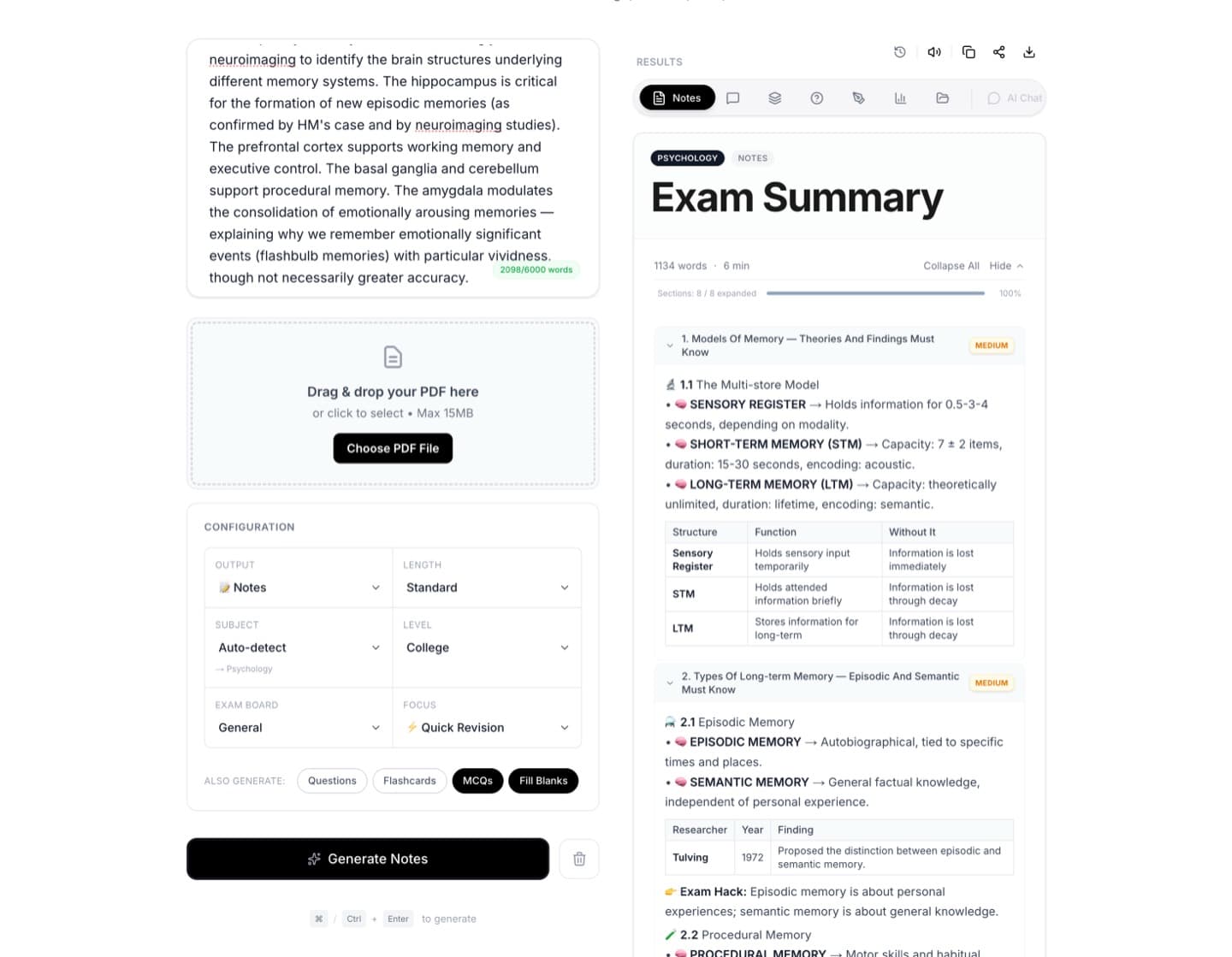
Product workflow preview
What the workflow looks like in Aripsy
Students can paste a focused AQA A-Level Biology topic, choose Biology and AQA settings, generate notes, then turn checked points into flashcards, MCQs, or essay-plan prompts.
What is covered in AQA A-Level Biology?
AQA A-Level Biology revision includes molecular biology, cells, exchange and transport, energy transfer, genetics, ecology, control systems, gene expression, practical skills, data handling, and synoptic explanations. Aripsy helps students turn their own topic notes into shorter explanations and recall prompts.
Required practical and data-skills revision
Useful inputs include practical methods, variable tables, risk notes, graph examples, statistical test reminders, microscopy calculations, enzyme data, and ecology sampling results. Generated notes should keep method, controls, data handling, and evaluation wording clear.
Sample A-Level Biology flashcards
Example cards include: What is tertiary structure? The overall three-dimensional folding of a polypeptide caused by interactions between R groups. Why can high temperature denature enzymes? It disrupts bonds maintaining tertiary structure and changes the active site shape.
Common mistakes to check before revising
Students often write GCSE-level definitions, skip units in calculations, confuse correlation with causation, or describe practical results without linking them to evidence. Generated notes should be checked against the current specification, class notes, and mark schemes.
How to revise AQA Biology with Aripsy
Use one topic or practical at a time. Paste notes, generate a structured summary, verify key facts, then create flashcards, MCQs, or essay prompts from the corrected material.
Using AI for synoptic Biology revision
Synoptic revision needs links across topics. Use Aripsy to organize source material and generate prompt cards, but practise full explanations and essays yourself using mark schemes and course guidance.
Useful student workflows
Topic review
Turn notes on biological molecules, cells, exchange, genetics, ecology, or energy transfer into concise revision notes and recall prompts.
Required practical recap
Paste method notes and convert them into variables, controls, equipment, risk points, data handling, and evaluation questions.
Synoptic essay planning
Use checked notes to build prompt cards that connect processes across modules before practising full essay responses.
Why A-Level Biology pages need more than topic names
A-Level Biology revision depends on precise vocabulary, data interpretation, practical understanding, and connections between modules. A useful page should include practical checks, realistic flashcards, common mistake warnings, and source verification rather than simply swapping "Biology" into a generic notes page.
What to paste for better AQA Biology notes
The best input is a focused textbook section, class handout, practical method, corrected past-paper answer, graph explanation, or essay plan. Include definitions, diagrams described in words, data values, and mark-scheme corrections where possible so generated notes stay specific.
Turning Biology notes into active recall
After checking generated notes, turn definitions into flashcards, practicals into variable prompts, graphs into interpretation questions, and essay plans into retrieval cards. This keeps revision active and helps reveal weak links before past-paper practice.
Sources and further reading
These independent education resources inform the study habits discussed on this page. Always follow your teacher, tutor, specification, or official exam guidance first.
Topics Supported
Ready to revise with less friction?
Join over 50,000 students using Aripsy to study smarter, not harder.
Supported Subjects
Biology, Chemistry, Physics, Mathematics, History, Geography, Economics, Business, Psychology, Computer Science, English Literature.
Perfect for
CORE TOOLS
EXAM SPECIFIC
Explore More AI Study Tools
📐 AQA GCSE Maths
Revise AQA GCSE Maths with method notes, formula flashcards, and practice prompts.
📖 AQA GCSE English Literature
Revise set texts, quotes, themes, and poetry comparisons with checked study prompts.
📐 Edexcel GCSE Maths
Revise Pearson Edexcel Maths with method notes, flashcards, and practice prompts.
🧬 Edexcel GCSE Biology
Revise Pearson Edexcel Biology with notes, flashcards, practical checks, and questions.
🧠 AQA A-Level Psychology
Revise AQA Psychology with AO1, AO2, AO3, research methods, and evaluation prompts.
⚗️ AQA A-Level Chemistry
Revise AQA Chemistry with mechanisms, calculations, practicals, and flashcards.